
How It Works
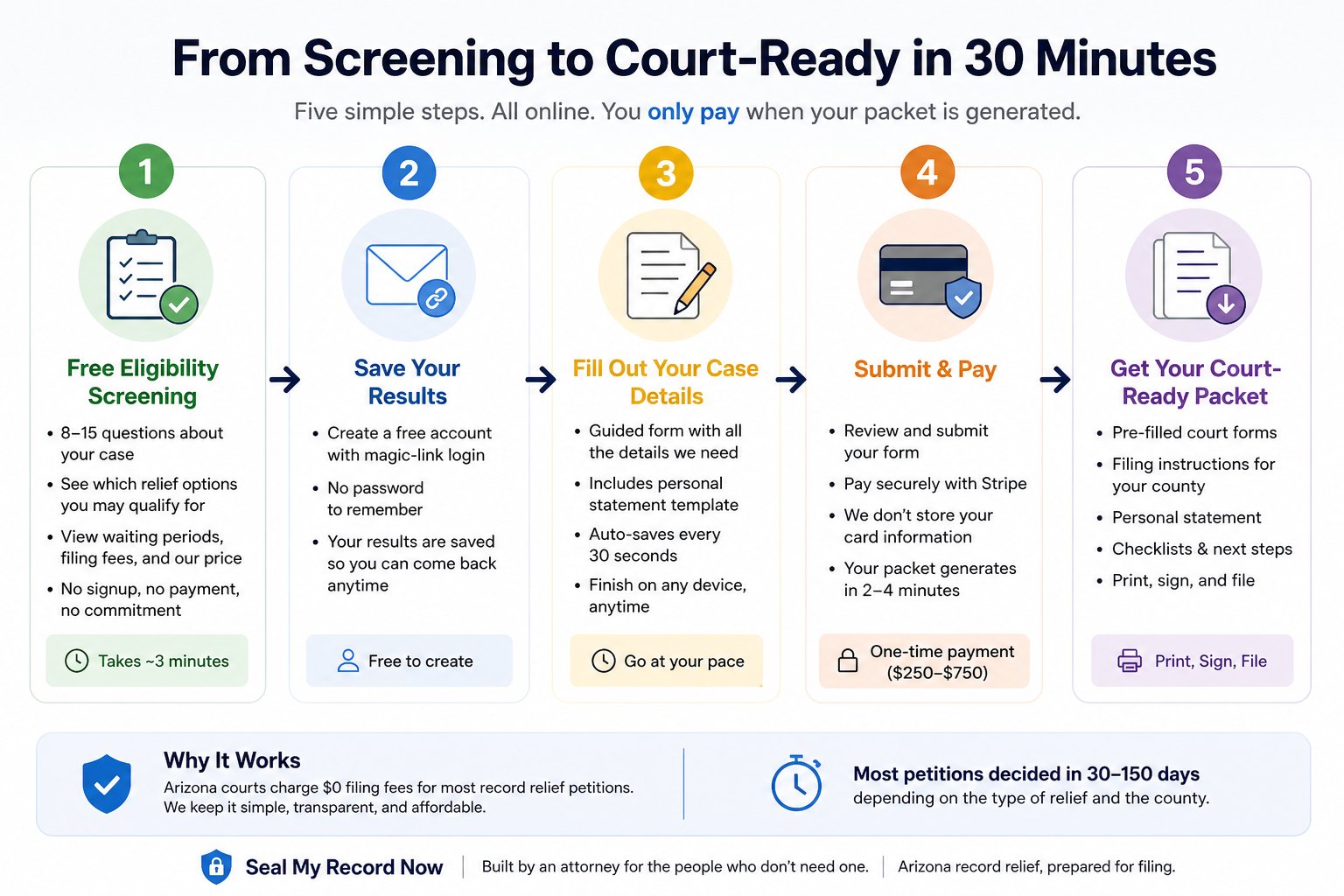
From screening to court-ready packet in 30 minutes.
Five steps, all online. You only pay when your packet is generated.
Ready to see what you qualify for?
Free screening tells you exactly which Arizona record-relief paths apply to your case.
Start the free screening →Read the full step-by-step (long form)
Step 1 — Free Eligibility Screening
The screening asks 8-15 questions about your case. Things like: which Arizona county handled it, was it a felony or misdemeanor, what offense class, was there a victim, did you complete probation, have you paid restitution, are you a first-time offender, etc.
The questions adapt based on your answers — you only see what's relevant to your case. Most people finish in a few minutes.
At the end, we tell you:
- Which Arizona statutes potentially apply to your case
- Which paths you appear to qualify for and which you don't
- The waiting period (if any) for each path
- The filing fee (typically $0)
- Our service price for each path
- Recommendations on filing strategy when multiple paths apply
No signup, no payment, no commitment. If you don't qualify or change your mind, you walk away with no obligation.
Step 2 — Sign Up to Save Your Results
If you want to proceed, you create a free account. We use magic-link sign-in — you give us your email, we send you a one-tap login link. No password to remember.
Your screening results are saved to your account. You can come back later, share with a family member, or take notes before deciding what to file.
Step 3 — Fill Out Your Case Detail Form
This is where we collect everything we need to prepare your petition. The form is split into sections so you don't get overwhelmed:
- Personal info — name, DOB, current address, contact info
- Case info — case number, court, charges, dates, judge name
- Sentencing details — sentence imposed, completion dates, restitution
- Restitution & fines — amounts paid, payment proof
- Personal statement — guided template that asks the right questions for the relief you're seeking
- Required attachments — checklist of documents you'll need to gather
The form auto-saves your progress. Walk away, come back days later, finish on your phone — your work is preserved.
We use the personal-statement template approach because the personal statement is the single most important factor in discretionary relief. Judges read these. A good personal statement is the difference between granted and denied.
Step 4 — Submit & Pay
When your case detail form is complete, you click Submit. Only at this point do we charge. You enter payment details and pay in full ($250-$750 depending on the service).
Payment is processed by Stripe — we don't store credit card information.
The moment payment clears, your packet generates. Typical generation time: 2-4 minutes.
Step 5 — Print, Sign, File
Your packet includes:
- The official AZ court petition (or MVD form for Admin Per Se) with all your information pre-filled into the form fields
- A pre-fill review checklist — go through every item to verify accuracy before signing
- County-specific filing instructions — exact court address, hours, e-filing portal access (if available), how many copies, what to bring
- Your personal statement formatted for filing
- Required attachments checklist — documents you'll need to gather
- Prosecutor service instructions — addresses, mailing requirements, certificate of service
- What happens next — typical timeline, what to expect, what to do if denied
Print the packet, sign where indicated, gather attachments, and file. Most petitions are decided within 30-150 days depending on the type of relief and the county.
What we don't do
To be clear about scope:
- We don't represent you in court. If a hearing is set, you appear yourself or hire an attorney. (Most petitions are decided on the papers without a hearing.)
- We don't appeal denials. If your petition is denied, we can't appeal it. Hire a licensed Arizona attorney.
- We don't gather your attachments for you. Court records, discharge papers, and payment history are documents only you can request from the relevant agency.
- We don't file on your behalf. You file the packet yourself at the court clerk's office or through e-filing if your county supports it.
- We don't provide legal advice. Seal My Record Now is a document preparation service — not a law firm. If you need legal advice, hire a licensed attorney.
Why the $0-court-fee design matters
Arizona courts charge no filing fee for set-aside, sealing, civil rights restoration, firearm restoration, marijuana expungement, or Class 6 designation petitions. The legislature deliberately removed filing fees to make these remedies accessible.
When attorneys quote you "$2,000 plus court fees," there are no court fees. Same when paralegals quote you "$1,200 plus filing." There's nothing to add. We tell you this upfront because most providers don't.
What if I get denied?
If your petition is denied, the judge issues a written order explaining why. Common denial reasons:
- Outstanding restitution or fines (cure: pay them, refile)
- Incomplete sentence terms (cure: complete them, refile)
- Subsequent conviction during waiting period (cure: complete new waiting period)
- Active warrant or pending case (cure: resolve, refile)
- Discretionary denial despite eligibility (cure: hire an attorney for refiling)
For sealing under § 13-911, you must wait 3 years from the denial before refiling. Other remedies have no statutory wait — refile when the denial reason is cured.